5 Awesome Duplicati Alternatives
 Yulei Chen
Duplicati is a free, open-source backup tool that lets you create encrypted, incremental backups to virtually any cloud storage provider, including Amazon S3, Backblaze B2, Google Drive, OneDrive, and many more. It comes with a web-based UI, scheduling, and AES-256 encryption out of the box. The software itself is completely free to self-host, but if you want centralized management via the Duplicati Console, plans start at $2/machine/month (billed yearly) or $2.50/machine/month (billed monthly).
If you want full control over your backup infrastructure without managing servers yourself, you can self-host Duplicati on Sliplane for just €9/month per server.
But Duplicati isn't the only backup tool out there. Whether you're looking for something faster, more minimal, or with a different architecture, here are 5 awesome alternatives worth checking out.
1. Restic
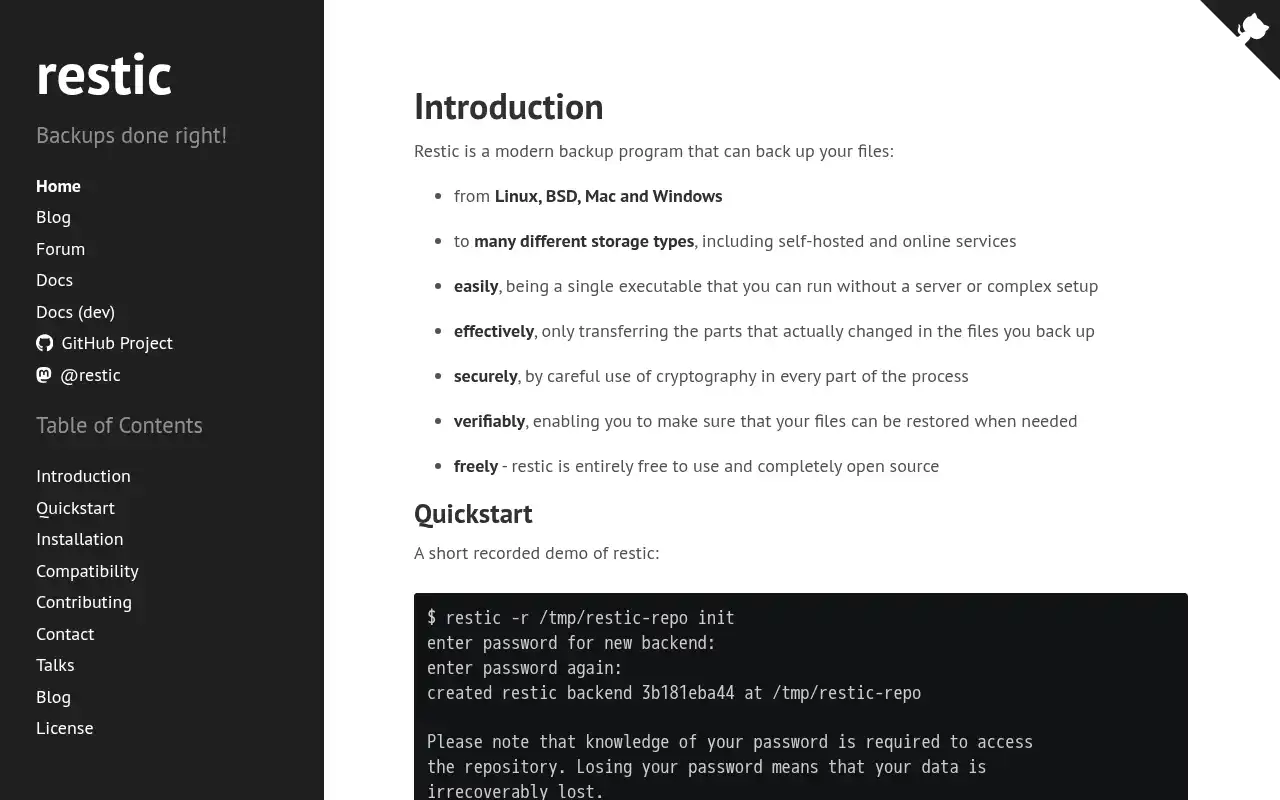
Restic is a fast, secure, and efficient command-line backup program that has become one of the most popular open-source backup tools, with over 27,000 GitHub stars. Unlike Duplicati's web UI approach, Restic is built for the terminal and focuses on doing one thing really well: creating encrypted, deduplicated snapshots of your data.
- Features: AES-256 encryption by default, content-defined chunking for deduplication, supports multiple backends (S3, B2, Azure, GCS, SFTP, local), snapshot browsing via FUSE mount, fast restore, cross-platform (Linux, macOS, Windows, BSD), and easy verification with
restic check. - Why You Should Use It: If you prefer the command line and want something lightweight and blazing fast, Restic is hard to beat. Its deduplication is excellent, backups are verifiable, and it integrates well with cron jobs and automation scripts. The single-binary design makes it trivially easy to install and deploy.
- Why Not: There is no built-in web UI or scheduler. You need to set up cron jobs or use a wrapper like Backrest for scheduling and monitoring. It also lacks Duplicati's point-and-click setup, which can be a hurdle for less technical users.
- Pricing: Restic is 100% free and open-source under the BSD 2-Clause license. You only pay for whichever storage backend you choose (e.g., Backblaze B2 at ~$0.006/GB/month or rsync.net at $0.008/GB/month).
2. BorgBackup
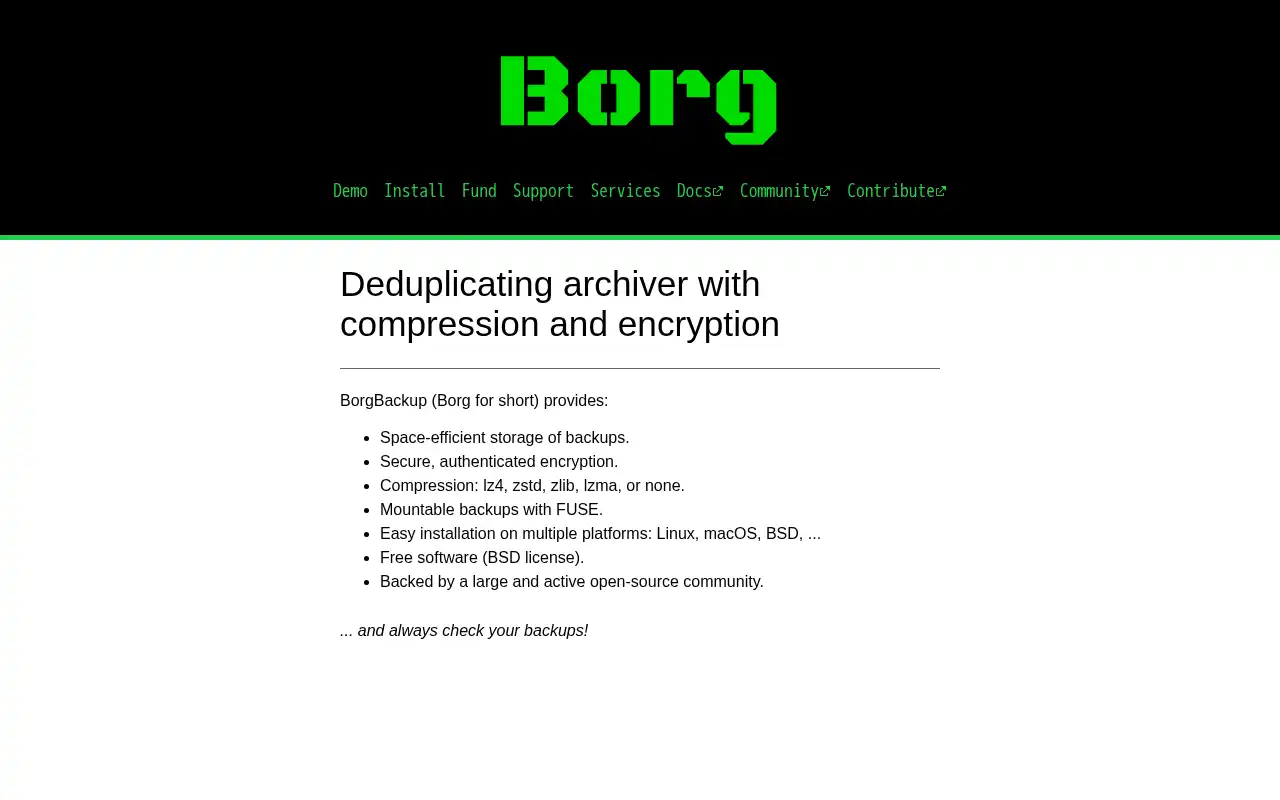
BorgBackup (or simply "Borg") is a deduplicating archiver with compression and authenticated encryption. It's one of the oldest and most trusted open-source backup tools, known for its rock-solid reliability and efficient storage usage.
- Features: Content-defined chunking deduplication, multiple compression algorithms (LZ4, zlib, LZMA, zstd), authenticated encryption (AES-256-CTR with HMAC-SHA256), append-only mode for ransomware protection, mountable backup archives via FUSE, pruning policies, and remote backup over SSH.
- Why You Should Use It: BorgBackup is the gold standard for deduplication efficiency. If storage savings are your top priority, Borg consistently outperforms most alternatives. It is battle-tested, extremely stable, and trusted by system administrators worldwide. The append-only repository mode is excellent for protecting against ransomware or accidental deletions.
- Why Not: Like Restic, Borg is CLI-only with no built-in web UI. It primarily supports SSH-based remote backends and lacks native support for cloud storage like S3 or B2 (you would need to combine it with tools like rclone). The Borg 2.0 migration has been slow, which can make the ecosystem feel stagnant.
- Pricing: BorgBackup is completely free and open-source (BSD license). For managed hosting, BorgBase offers plans starting at $2/month with 10 GB free forever. Self-hosting Borg on your own server costs nothing beyond the server itself.
3. Kopia
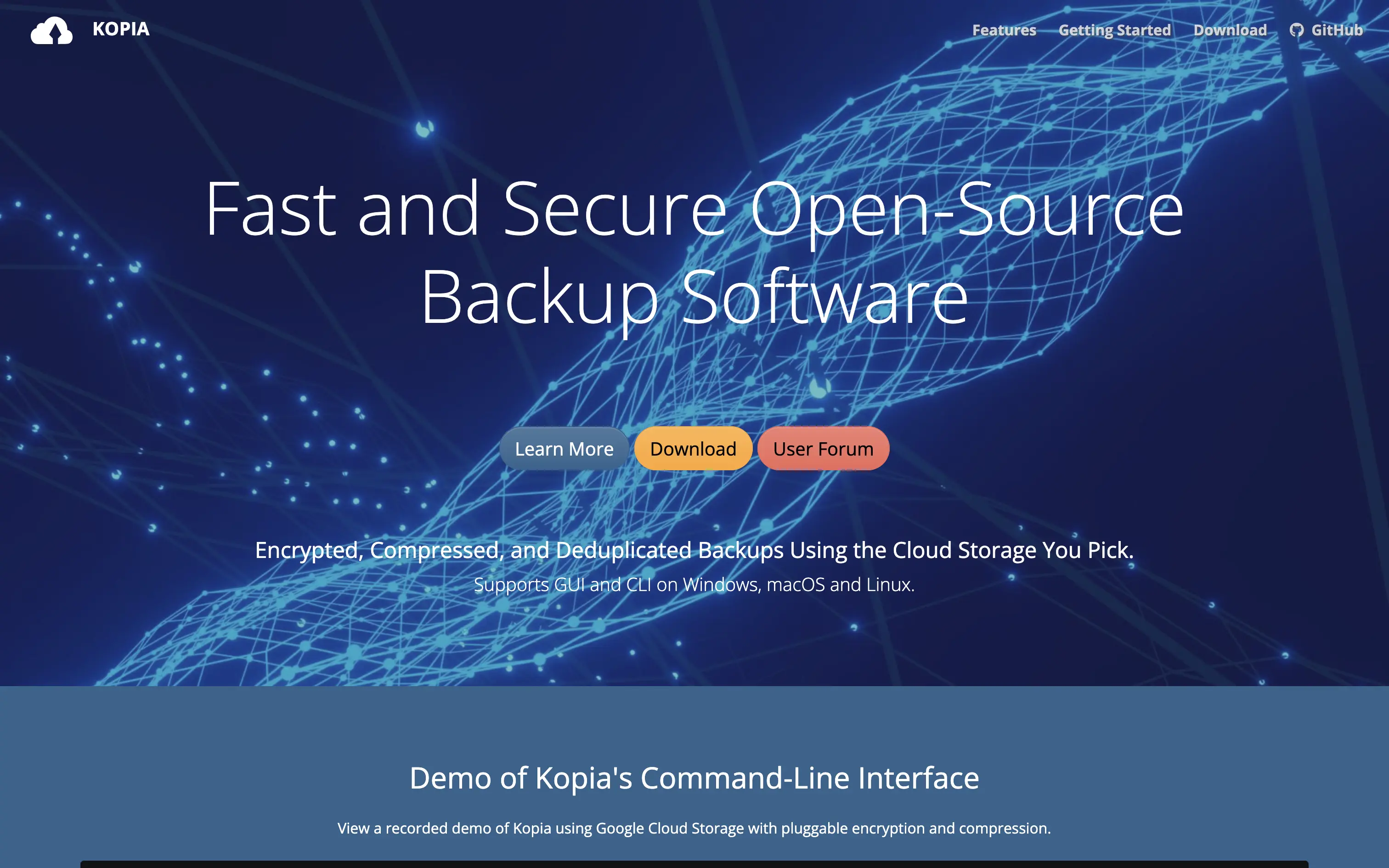
Kopia is a modern, fast backup tool that strikes a balance between Restic's CLI power and Duplicati's user-friendly approach. It offers both a command-line interface and a graphical UI, making it accessible to a wider range of users.
- Features: Content-defined chunking deduplication, client-side AES-256 encryption, multiple compression algorithms, built-in GUI for Windows/macOS/Linux, snapshot policies and scheduling, supports S3, B2, Azure, GCS, SFTP, WebDAV, and local storage, repository server mode for multi-user setups, and error correction with Reed-Solomon codes.
- Why You Should Use It: Kopia is the best "middle ground" alternative. You get Restic-level performance and deduplication with a built-in GUI that rivals Duplicati's ease of use. The repository server mode is a standout feature for teams, letting you share a backup repository securely across multiple machines without exposing storage credentials.
- Why Not: Kopia is newer and has a smaller community than Restic or Borg. The GUI, while functional, can feel rough around the edges. Documentation is improving but still not as comprehensive as more established tools.
- Pricing: Kopia is 100% free and open-source (Apache 2.0 license). You only pay for your storage provider. A typical setup with Backblaze B2 costs around $0.006/GB/month for storage.
4. UrBackup
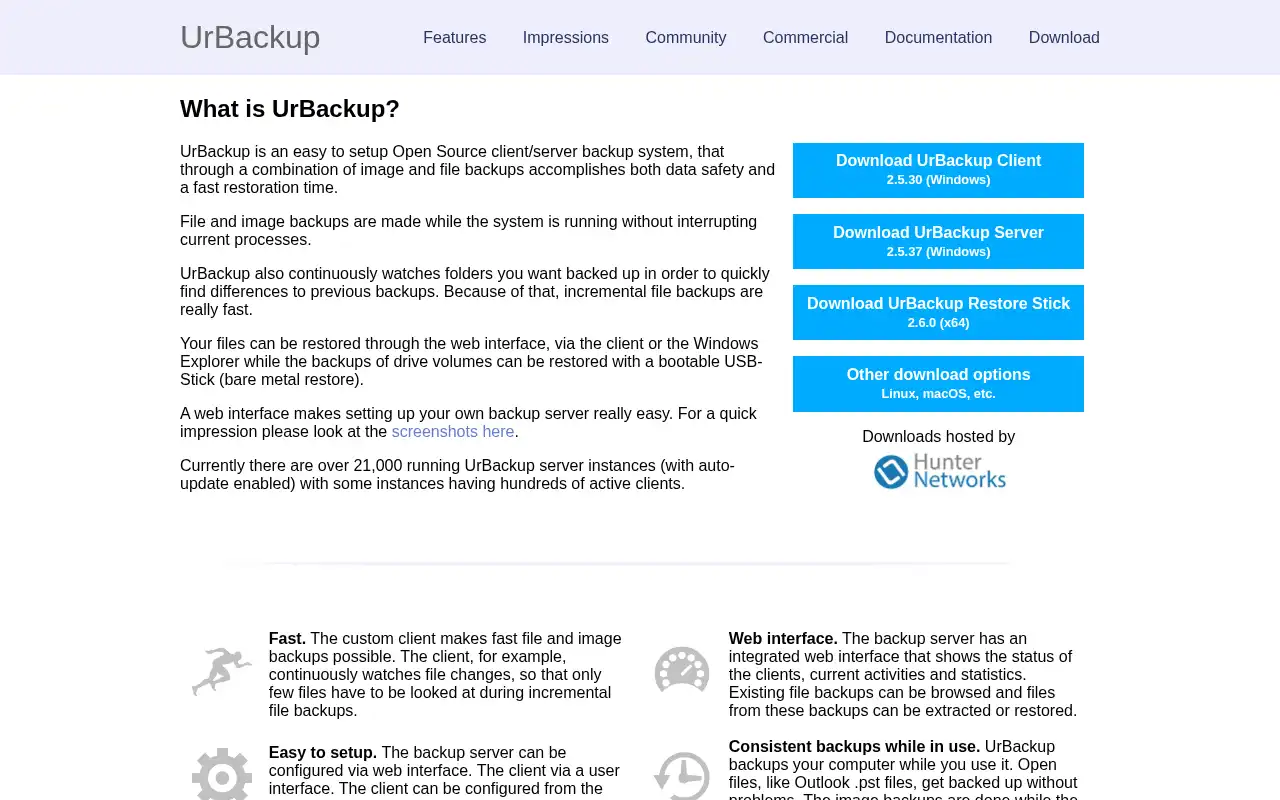
UrBackup is a client/server backup system with a full web interface, designed for backing up multiple machines on a network. Unlike the other tools on this list that focus on individual machine backups, UrBackup is built for managing backups across your entire infrastructure from a central server.
- Features: Full and incremental image backups, file-level backups, centralized web management dashboard, automatic client discovery on the network, internet-mode for backing up remote clients, bare-metal restore via bootable USB, cross-platform clients (Windows, Linux, macOS), and email notifications.
- Why You Should Use It: If you need to back up multiple machines (workstations, servers, VMs) from a single dashboard, UrBackup is the closest open-source alternative to commercial solutions like Veeam. The web UI makes it easy to monitor backup status across all clients, and the bare-metal restore feature is a lifesaver for disaster recovery.
- Why Not: UrBackup is more complex to set up than single-machine tools like Restic or Duplicati. It requires running a dedicated server component. Native cloud storage support is limited; it's primarily designed for local or network-attached storage. The UI looks dated compared to modern alternatives.
- Pricing: The core software is free and open-source (AGPLv3). Commercial add-ons include Change Block Tracking for Windows at €15.50 per client and a Hyper-V backup client. The UrBackup Appliance is available via Infscape with custom pricing.
5. Rclone
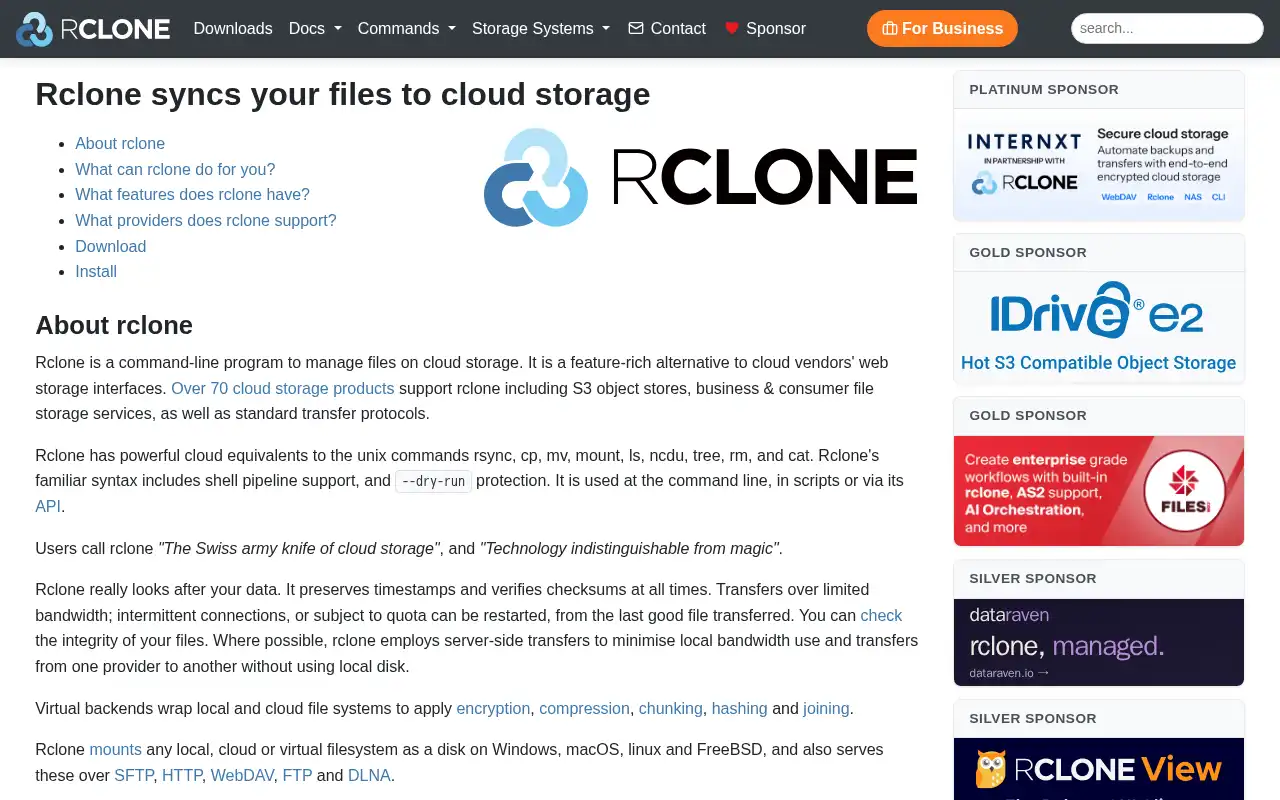
Rclone is often called "rsync for cloud storage." It is a powerful command-line tool for managing, syncing, and backing up files across over 70 cloud storage providers. While not a traditional backup tool with snapshots and deduplication, Rclone excels at moving data between storage backends and can serve as a flexible backup solution.
- Features: Supports 70+ cloud storage providers (S3, GCS, Azure, Dropbox, Google Drive, OneDrive, SFTP, and many more), sync, copy, and move operations, client-side encryption (crypt), bandwidth limiting, filtering with include/exclude patterns, mount cloud storage as a local drive via FUSE, and a built-in web UI (rclone rcd).
- Why You Should Use It: If your primary goal is syncing data to cloud storage or migrating between providers, Rclone is unmatched. No other tool supports as many backends. It is also great as a "transport layer" that you can pair with other backup tools, for example using Rclone as a backend for Restic. The
rclone synccommand with--backup-dirgives you simple versioned backups. - Why Not: Rclone is not a backup tool in the traditional sense. It does not do deduplication or create snapshots by default. You need to build your own backup strategy around it (scheduling, retention policies, verification). Without careful configuration,
rclone synccan delete files at the destination if they're removed from the source. - Pricing: Rclone is 100% free and open-source (MIT license). You only pay for your chosen cloud storage. Third-party GUIs like RcloneView offer free and paid tiers, but the core tool is completely free.
Conclusion
| Tool | Best For | Ease of Setup | Focus | Cloud Pricing |
|---|---|---|---|---|
| Duplicati | GUI-based encrypted backups | Easy (web UI) | All-in-one backup with UI | Free (self-hosted), $2/machine/mo console |
| Restic | Fast CLI backups | Moderate (CLI) | Encrypted snapshots | Free & open-source, pay for storage only |
| BorgBackup | Maximum deduplication | Moderate (CLI) | Deduplicated archives | Free & open-source, BorgBase from $2/mo |
| Kopia | GUI + CLI flexibility | Easy (GUI available) | Modern backup with UI | Free & open-source, pay for storage only |
| UrBackup | Multi-machine network backups | Complex (client/server) | Centralized backup management | Free core, add-ons from €15.50 |
| Rclone | Cloud storage sync | Moderate (CLI) | Cloud file management | Free & open-source, pay for storage only |
Each tool fills a different niche: Restic for fast, scriptable CLI backups; BorgBackup for maximum storage efficiency; Kopia for a modern GUI+CLI hybrid; UrBackup for centralized multi-machine management; and Rclone for unmatched cloud storage connectivity.
Duplicati remains a great choice if you want a web-based UI, wide cloud storage support, and set-it-and-forget-it scheduling. But if you need raw speed (Restic), better deduplication (Borg), a modern desktop app (Kopia), network-wide management (UrBackup), or cloud sync superpowers (Rclone), one of these alternatives might be a better fit.
If you want to get started with Duplicati quickly, check out our guide on self-hosting Duplicati the easy way. And if you're looking for more backup strategies, take a look at 4 easy ways to backup Docker volumes.